

4D BIM is worth the investment when the construction sequence decides whether a general contractor can win the work, build it as planned, and deliver it on time. General contractors use it to show owners a credible plan during pursuit, to test logistics and schedule assumptions before work is committed, and to keep crews aligned on what comes next once construction starts.
General contractors face scheduling problems when crews can’t follow the planned sequence. For example, a crane may not reach the required location; equipment may arrive before the installation area is ready, or multiple crews may need the same space at the same time. A construction schedule can show activity dates and dependencies, but it does not always make these site, access, and work-zone constraints clear before work begins.
4D BIM gives teams a time-based way to test whether crews can actually build the planned sequence before site conditions limit the options. However, it is not required for every project. So, when should a general contractor invest in 4D BIM? This article covers the project conditions that justify 4D BIM, how it supports pursuit, preconstruction, and construction, and a data center case study involving critical dry-cooler equipment.

When Is 4D BIM Worth the Investment?
4D BIM is worth the investment when the construction sequence affects how the project is won, planned, or built. Its value is clearest when a project has a sequencing or installation decision that the schedule and coordination meetings cannot settle. It increases further if the team would otherwise find the issue only after committing crews and equipment to the site, when the fix costs standby time and remobilization or forces crews to work out of sequence.
Four questions point to the projects where 4D BIM delivers the most value:
If the first answer is yes and at least one of the others is too, the project is a strong candidate for 4D BIM. If not, the GC should determine whether visualization provides enough planning or communication value to justify the effort.
What Types of Projects Benefit Most From 4D BIM?
Certain project types create these conditions more often because critical installations are closely tied to access, lifting, commissioning, or downstream trade work. These include:
These project types do not automatically require 4D BIM. The decision depends on whether an unresolved sequencing issue could affect equipment installation, trade access, or a completion milestone.
When to Use 4D BIM: Pursuit, Preconstruction, and Construction
4D BIM is most useful at the point when it can still influence a high-risk decision. During pursuit, this may mean showing that a proposed sequence addresses a construction constraint that will affect the selection process. During preconstruction, it may mean testing the plan before fabrication releases and lift plans are locked in.
During construction, 4D BIM keeps the plan visible to the people building it. Teams use it to compare planned and actual progress, prepare look-ahead views of the work expected in the coming weeks, and walk crews and subcontractors through the activities coming up next on site. When a material change puts a critical activity at risk, such as a late delivery or a lost crane window, the same model lets the team compare recovery options before committing more labor and equipment.
The goal is not to create a 4D model at every stage. It is to use one when the cost of changing the plan rises sharply.
Case Study: Planning a Critical Dry-Cooler Installation With 4D BIM
The Project Challenge
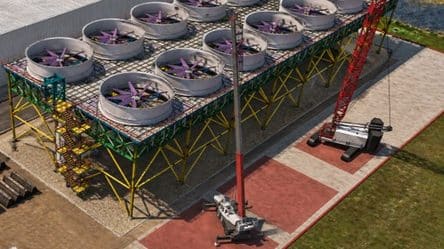
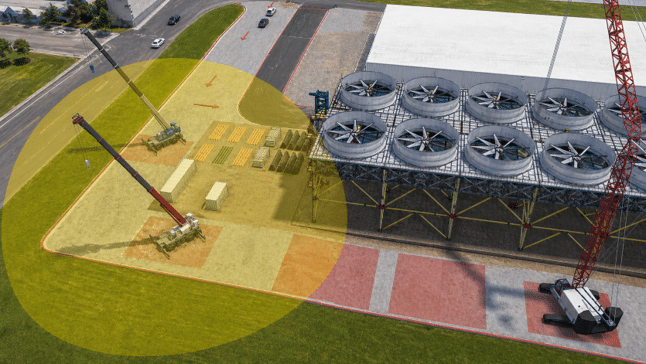
This case study involves a critical dry-cooler installation on a large data center project. The installation depended on significant crane operations, tight site constraints, and coordination among multiple parties. Key stakeholders included the general contractor, the crane company that engaged the 4D BIM team, and the mechanical equipment manufacturer.
Testing the Installation Strategy Before Construction
The 4D BIM model simulated the dry-cooler installation sequence and tested the proposed logistics and erection strategy before construction began. The team used the model to review the relationship between equipment installation activities, crane use, site access, and surrounding construction work.
The model served as a coordination tool for reviewing the installation approach before crews, cranes, and equipment were committed to the site. It allowed the team to:
- Test alternative erection and installation strategies
- Review crane requirements and dependencies
- Validate site logistics and work-zone conditions
- Assess how the installation sequence affected surrounding work
- Identify safety considerations before construction
- Establish a shared understanding of the intended sequence
Outcome: A Coordinated Crane and Installation Plan
The 4D BIM review let the team walk the lift, the access route, and the surrounding work before construction began. It gave the general contractor, crane company, and equipment manufacturer a shared basis for reviewing the installation strategy and making decisions before field execution.
The value was not the animation itself. It was the ability to review the proposed plan early enough to adjust the crane plan and the sequence while those changes were still cheap.
The Bottom Line for General Contractors
4D BIM is often associated with risk: the crane that cannot reach, the equipment that arrives too early. That is where it pays off fastest, but it is not the only reason to use it. The same model helps general contractors win work with a credible plan, test the assumptions behind the schedule, and keep every crew aligned on what comes next.