Live Webinar on Nov 10th: Data Center vs. Healthcare: A Practical Guide to Prefab Strategy. Join us!
×
Live Webinar on Nov 10th: Data Center vs. Healthcare: A Practical Guide to Prefab Strategy.

VDC improves process piping spooling efficiency by standardizing fabrication-ready deliverables, tracking spool drawings through quality control and approvals, and maintaining clear release records. On a semiconductor fab project, ENG combined these practices with project-specific automation to reduce spooling time by 40% while improving production schedule visibility.
On one of the world’s largest semiconductor manufacturing fab projects, design and fabrication had to happen simultaneously. P&IDs kept changing, four fabrication shops worked to different standards, and the client needed its shops running. ENG built a traceable VDC workflow that tracked every spool drawing from the model to client approval. By combining three different workflows and implementing a custom add-in, ENG cut spooling time by 40% and extended saving time in the production process.
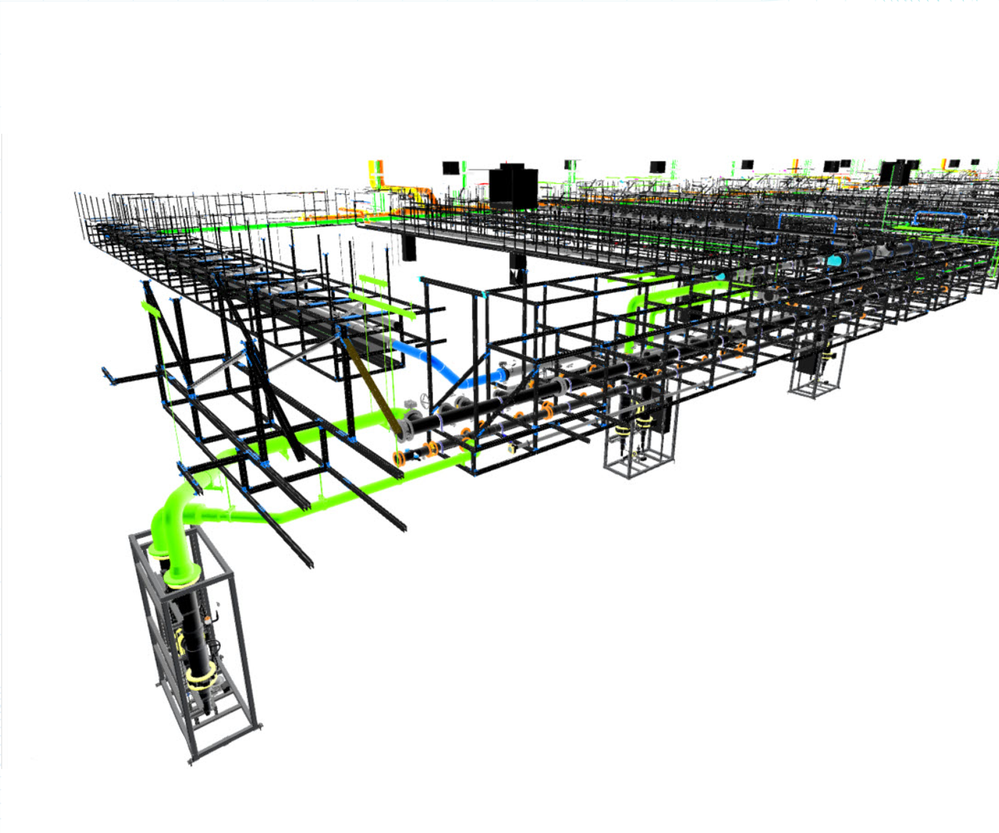
| Project type | Semiconductor fab, process piping |
| ENG scope | Process-piping mains and pipe racks: modeling, MEP coordination, spool drawings |
| Duration | 2 years (ongoing) |
| Team | 16 ENG modelers |
| Piping modeled | About 130,000 LF |
| Spool packages delivered | 900+ |
| Fabrication shops | 4 vendors |
| Platform | Revit, ClickUp, BIM360 and ACC |
ENG has also delivered remote electrical prefabrication for a semiconductor fab in Arizona for a 2.4 million sq ft.
In a conventional project sequence, teams design, model, coordinate, and only then release the work for fabrication. This semiconductor project gave ENG no such luxury. The client needed its shops running, because shop capacity costs real money, so the team coordinated and fabricated at the same time.
The four vendors did not work alike. Tolerances, stock, and methods differed from shop to shop, even for the same material. Meanwhile, the design never settled. The team started with P&IDs that looked final, then went past revision 13 as changes kept coming. Midway through, the general contractor changed, and a Revit upgrade made the transition harder.
Supply disruption added another layer. Although the valves had been approved, the specified models were unavailable. At one point, the team tracked two or three different valve models and brands for the same service. Any one of these problems is manageable. Together, over two years, they called for a different approach.
ENG couldn’t stop upstream changes, so it focused on how the team responded. Three lessons shaped that response.
Build a process before you build pipe.
ENG redefined what a finished deliverable meant. A clean, clash-free model had been the standard. On this project, the team prioritized fabrication-ready BIM to support spool production at the shop.
ENG also aligned its MEP coordination process with the GC’s. Each package sent to the shop included a report confirming it was clash-free in the model at the time of release. Changes kept arriving, but ENG now had a date, status, and proof, which gave it something to negotiate with.
Make every decision traceable.
With this much in motion, nobody could rely on memory or an inbox. ENG assigned each spool a single ID and used it to carry the work from scheduling through QC to client verification, all backed by one source of truth.
The software was only part of the answer. Daily meetings and the habit of knowing exactly who to go to made the tools worth using.
Standardize people, not just drawings.
ENG wrote its standards into a Standard Operating Procedure (SOP) with graphical guides and training. Anyone could build a full package from that single document, so nothing lived in one person’s head.
The SOP proved its value as people rotated on and off the project. Newcomers got up to speed without a drop in quality, and the standards held when the GC changed, so ENG did not have to start over.
ENG pulled these figures directly from the project’s tracking data, not a survey or an after-the-fact estimate.
How do you keep spool drawings moving when P&IDs continue changing, and fabrication shops are already working?
In this webinar, Gloria Luna, Director of Mechanical & Plumbing VDC, and Natalí Britos, BIM Project Manager, explain how ENG managed coordination, spool tracking, and standardized deliverables on a major semiconductor fab project.
Next step
See the workflows behind the 40% reduction in spooling time, including how the team managed drawing status, quality control, and changing project requirements.

