
Delivering LOD 400 Mechanical BIM within an existing, partially developed model can introduce significant coordination risks. ENG was brought in to provide Mechanical BIM services in a 160,000 SF laboratory warehouse model in Indiana. From the outset, the project presented a unique challenge: rather than starting with a clean BIM model, the BIM specialists worked within an existing client-provided model that required reorganization, refinement, and careful interpretation.
This article walks through the project sequence and highlights how ENG’s approach ensured model accuracy, reducing errors, costly rework, and on-site delays.
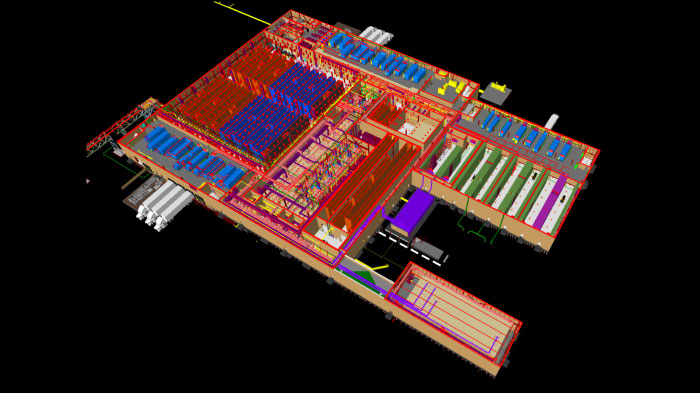
When ENG joined the project, the mechanical piping model already included connections to approximately 29 air-handling units (AHUs) distributed across mezzanine levels. However, these assemblies reflected an earlier design phase and did not meet LOD 400 Mechanical BIM standards.
Multiple documentation sources had to be reconciled, including:
This created coordination challenges requiring detailed cross-referencing and validation before assemblies could be finalized for fabrication. At this point, ENG’s task was clear: receive updated information, replace and rebuild the assemblies, and coordinate the piping systems to ensure accuracy.
Unlike projects that begin with clean modeling environments, this engagement required strategic restructuring of an active model.
The coordinated mechanical scope included:
Where BIM content was unavailable, the BIM team created and sourced components directly from equipment submittals, ensuring the model accurately reflected real-world conditions. Through continuous communication with the client, the project proceeded smoothly.
Throughout the project, Mechanical BIM coordination was facilitated through weekly meetings with the client. Although referred to as “BIM Coordination” by the client, these sessions primarily served as progress check-ins, ensuring continuous alignment with the client’s priorities and construction sequencing. The discussions focused on reviewing the work’s status, clarifying open items, and confirming the modeling and spooling scope.
Considering the BIM model was rebuilt to fabrication-level detail, precision was critical. Any discrepancy between the model and field conditions could have resulted in installation delays, material waste, or costly rework. The true measure of success came during installation.
“When the client sent photos of the installation, the components looked almost identical to what we had modeled. I had never worked with that level of detail before.”
— Agustin Vivar, BIM Specialist, ENG.
This level of model-to-field alignment confirmed the effectiveness of the LOD 400 coordination strategy and significantly reduced installation uncertainty.
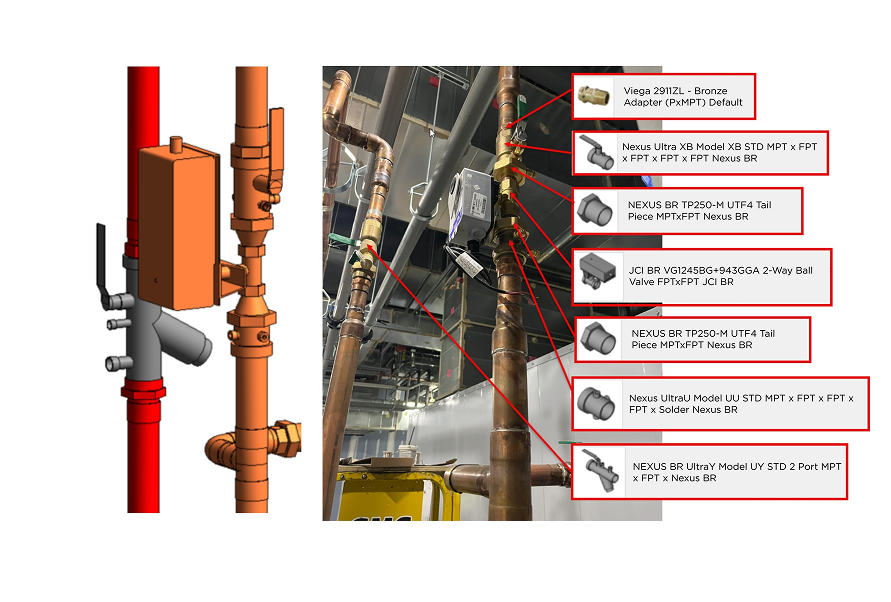
Deliverables were adapted to evolving project needs, reinforcing BIM not as a static design tool, but as an active driver of execution. At the end the project deliverables included:
These fabrication-ready outputs ensured the Mechanical BIM model was accurately represented in the field, enabling shop prefabrication and accelerated on-site installation.
ENG’s Mechanical BIM services improved constructability, reduced installation time, provided clearer documentation for field teams, and increased confidence in a complex laboratory environment. Ultimately, this case demonstrates how a pragmatic, execution-focused LOD 400 BIM strategy can unlock real value, even when starting from imperfect conditions.
Ready to eliminate rework and improve constructability with LOD 400 Mechanical BIM? Schedule a consultation with ENG today.