Live Webinar on Oct 15: VDC MEP Process Piping Lessons from a Semiconductor Plant. Join us!
×

In Revit, the connection was valid. In the field, it would have failed.
That failure would not have come from a clash, clearance issue, or modeling error. It would have come from galvanic corrosion in an Air Handling Unit (AHU). Caused by a direct dissimilar-metal connection between copper and stainless steel.
This is where LOD 400 BIM coordination becomes more than geometry verification. In this case, the project BIM team identified a copper-to-stainless steel connection that Revit accepted. Still, the field installation would have been exposed to long-term corrosion risk.
Beyond the case itself, the article covers what galvanic corrosion is, how the BIM team approached it, and best practices MEP teams can apply to prevent it on future projects.
Galvanic corrosion occurs when dissimilar metals contact each other in the presence of moisture. Since metals have different electrochemical potentials, one metal corrodes faster over time.
In HVAC piping systems, this process is most commonly found at piping joints and can be visually observed on the exterior of the pipe. Internal damage downstream of the contact point can also develop, making it harder to detect until it has already progressed.
While pipe joints are the most common site of galvanic action, improper materials for pipe hangers can trigger the same process. This is a detail easy to overlook during coordination, but directly relevant at the LOD 400 modeling stage.
The project scope was LOD 400 BIM, issued to construction, covering mechanical piping and instrumentation for HVAC systems on an Air Handling Unit. At this stage, each modeled component, fitting, and connection should match what will be installed in the field
During coordination, the BIM team identified a connection between a copper female adapter and a stainless steel male NPT offset flex pipe. In Revit, the connection was placed cleanly. No warning, no clash, and no flag indicated the long-term corrosion risk at the AHU connection.
The problem was not geometric. It was material.
Revit validated the connection because the components were geometrically and parametrically compatible. However, BIM coordination at LOD 400 extends beyond geometry. Material compatibility, specification compliance, and constructability risks still require review by the coordination team.
Without that review process, the connection could have reached installation despite the long-term corrosion risk.
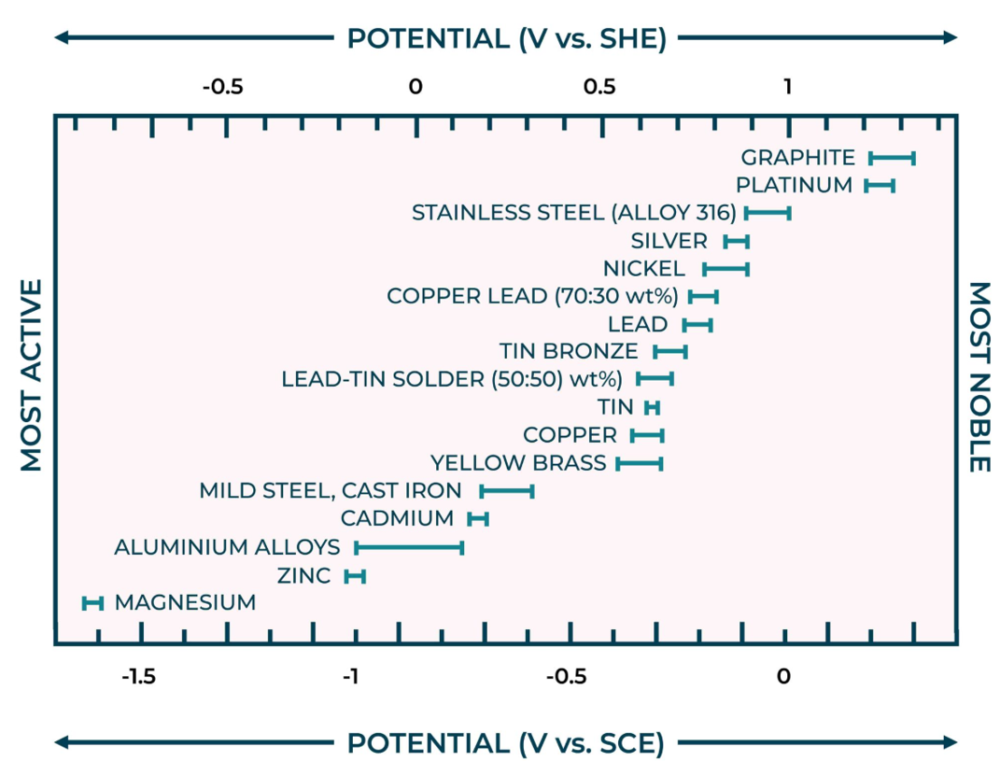
Stainless steel is significantly more noble than copper on the galvanic series, creating enough electrical potential difference to accelerate corrosion at the joint.
That difference is wide enough to drive dissimilar-metal corrosion at the joint. In an HVAC system, where moisture is a permanent condition, the deterioration would be continuous. As a result, the project team rejected that direct connection, proposing two alternative assemblies to move forward.
Once the direct connection was rejected, the team modeled two compliant alternatives. Both eliminate or reduce the galvanic corrosion risk, and the right choice depends on the dielectric specifications in the trade general notes and the client’s approved submittal.
The assembly modeled: copper pipe Type L PE connected through a Mueller 90° copper male street elbow, followed by a dielectric union, into the stainless steel male NPT offset flex pipe thread.
A dielectric union contains an insulating sleeve and a non-conductive gasket that physically separates the copper and stainless steel surfaces. Without electron transfer, no galvanic cell forms, and no corrosion occurs at the joint. This is the only solution in this case that provides complete electrical isolation between the two metals.
The second assembly places a Merit Brass BR Class 125 Union FPTxFPT as a transitional fitting between the copper male adapter and the stainless steel male NPT thread.
By introducing a brass transition point, the potential difference at each joint drops from roughly 160 mV to two smaller gaps of approximately 60–80 mV each. This significantly reduces the corrosion driving force. In a threaded configuration, the brass union also functions as a sacrificial anode, corroding preferentially to protect the copper and stainless steel components on either side.
The AHU case is not an isolated scenario. Any MEP project with dissimilar metals in the piping system carries the same risk. The following best practices help BIM teams catch and resolve those connections before the model reaches the field.
Preventing galvanic corrosion in HVAC piping requires more than correct geometry in a BIM model. Material compatibility, dielectric isolation requirements, and specification compliance must also be reviewed during coordination.
This AHU case study demonstrates how LOD 400 BIM coordination can identify dissimilar metal risks before installation, helping project teams avoid premature corrosion, maintenance issues, and long-term system failures in the field.
At ENG, our BIM specialists support MEP contractors and project teams with coordination workflows focused on constructability, specification compliance, and installation-ready modeling that helps prevent costly field issues before construction begins.
Need a constructability-focused LOD 400 review for HVAC piping and equipment connections? Let’s talk
Author: Sebastian Filigrana Medina, BIM Specialist