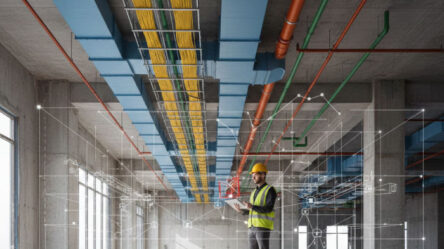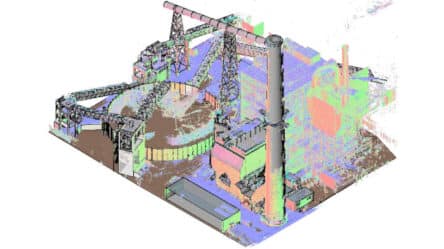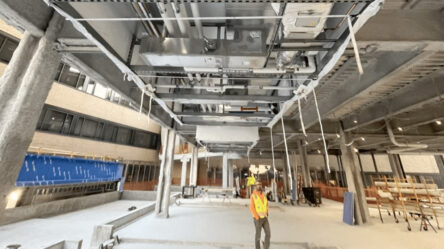


As projects grow in complexity and schedules tighten, the conversation around BIM is no longer about adoption but rather its performance.
The true value of BIM now depends on how effectively it supports construction execution, trade coordination, prefabrication, and field installation. Recent industry discussions on BIM trends for 2026 highlight how BIM has evolved from a design tool to a construction-driven solution, influencing how work is planned, managed, and delivered.
For MEP contractors, the most significant BIM trends are not about new software capabilities but about improving workflows, increasing accountability, and ensuring better alignment between models and real-world installations. Contractors who understand and adopt these changes will be in a stronger position to reduce rework, meet tighter schedules, and meet rising owner expectations. Below are the top five BIM trends in 2026 that every MEP contractor, owner, and decision-maker should be aware of.
Trend #1: AI-Assisted Clash Detection for MEP Contractors
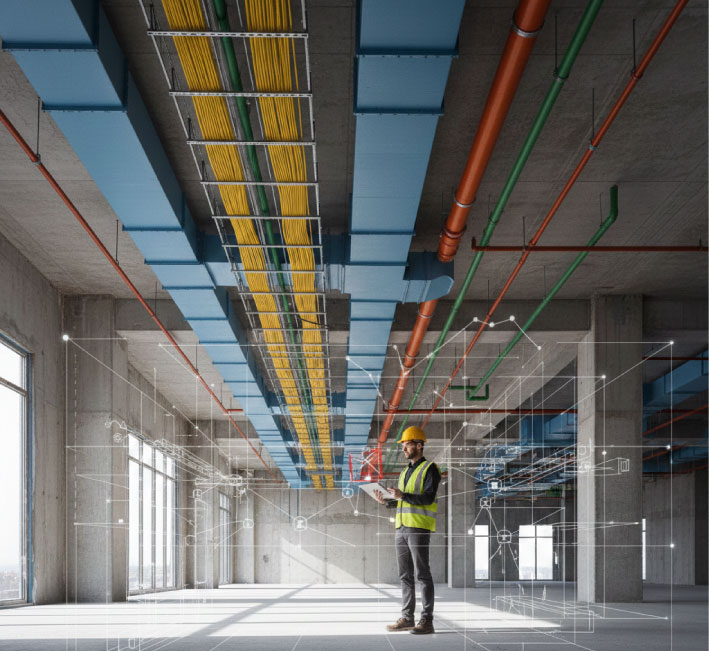
One of the most important BIM trends for MEP contractors is the use of AI-assisted clash detection. AI helps contractors by grouping similar clashes, removing duplicates, highlighting high-risk issues, and suggesting possible options based on learned patterns. Far from replacing human expertise, AI supports contractor decision-making by accelerating the coordination process. It reduces manual effort and allows BIM teams to focus on supervising quality while making high-value decisions on system coordination. For contractors managing multiple projects, AI-driven clash detection translates into measurable benefits like:
- Reduced rework caused by late issue resolution
- Better utilization of senior staff time
- More predictable handoff to prefabrication and field installation
As a result, contractors can accelerate workflows and improve overall coordination efficiency without losing control over the outcomes.
Trend # 2: BIM Trends for MEP Contractors: Constructability Knowledge
Another major BIM trend in 2026 for MEP contractors is the growing importance of constructability knowledge. As construction projects become more complex, understanding how designs translate into real-world construction is essential to perform tasks more efficiently. Long ago were the days when models needed to look good on paper; now, contractors need field expertise to ensure models are practical, installable, and coordinated across all trades. Ultimately, this field expertise means:
- Better decision-making early in the design and coordination process, avoiding issues that could cause delays or rework during installation
- Fewer surprises in the field because designs are built with real-world considerations in mind, making it easier to follow models on-site without major adjustments
- A seamless handover to prefabrication and installation teams, as models are developed with actual construction methods in mind
By collaborating with field-experienced BIM professionals, MEP contractors gain a significant advantage: they can rely on BIM that’s designed with the build process in mind, improving productivity, reducing rework, and lowering project risks.
Trend #3: Cloud-Based BIM and Connected Coordination Workflows
During the pandemic, cloud-based BIM became a lifeline for many BIM teams needing to collaborate remotely. Yet the BIM trend in 2026 now is to add artificial intelligence to interact with the cloud. This concept means adding agents to interact with the model, such as validation and calculation tools, to ensure compliance in real time. The real power of cloud-based BIM is that everyone involved, designers, engineers, and contractors, can work on the same model at the same time. Whether you’re working from the office, the job site, or remotely, the model stays synced in the cloud and updates instantly. This makes sure everyone is on the same page without delays or misunderstandings.
With cloud-based BIM, you create a living, dynamic model that connects tools, teams, and data to keep things moving, reducing hours of rework.
Trend #4: Digital Twins and Lifecycle BIM for MEP Contractors
Over the past years, maintenance documentation such as manuals, service logs, warranties, and as-built drawings was handed over in binders or loose files. Over time, that information was lost, outdated, or dependent on individual knowledge. A significant trend now is to centralize this data in a cloud-based BIM environment, turning the model into a visual interface where facility teams can navigate the building in 3D, select systems such as electrical panels or HVAC units, and instantly access specifications, service history, and related documentation.
When connected to sensors or building management systems, the Digital Twin can display live operational data directly within the model. For MEP contractors, this trend elevates the quality of project handover, reduces information loss, and strengthens their role beyond installation. Delivering lifecycle-ready BIM data is becoming a competitive advantage as owners increasingly expect operational transparency from day one.
Trend #5: Model Driven Prefabrication and Modular Delivery
One of the most impactful BIM trends for MEP contractors in 2026 is the move toward model-driven prefabrication and modular delivery. Prefabrication itself is not new; what is changing is the level of model accuracy and coordination required to drive fabrication directly from BIM. Fully detailed, constructability-informed models are now being used to produce spools, corridor racks, equipment skids, and multi-trade modules in controlled shop environments before installation begins. When BIM becomes the fabrication driver rather than just a coordination reference, contractors gain tighter control over material quantities, installation sequencing, and labor planning. This shift reduces field rework, shortens installation durations, improves safety conditions, and increases schedule predictability. These are all critical advantages in a market defined by labor shortages and compressed timelines.
Key Takeaways
In 2026, BIM trends for MEP contractors are far from centered on modeling capability, but rather on construction performance. AI-assisted coordination, model-driven prefabrication, and lifecycle value are among the main topics discussed today. Contractors who align their workflows with these shifts will reduce rework, improve installation accuracy, and strengthen their role in long-term project delivery.
To explore how these BIM trends can be applied to your next project, contact our ENG team.